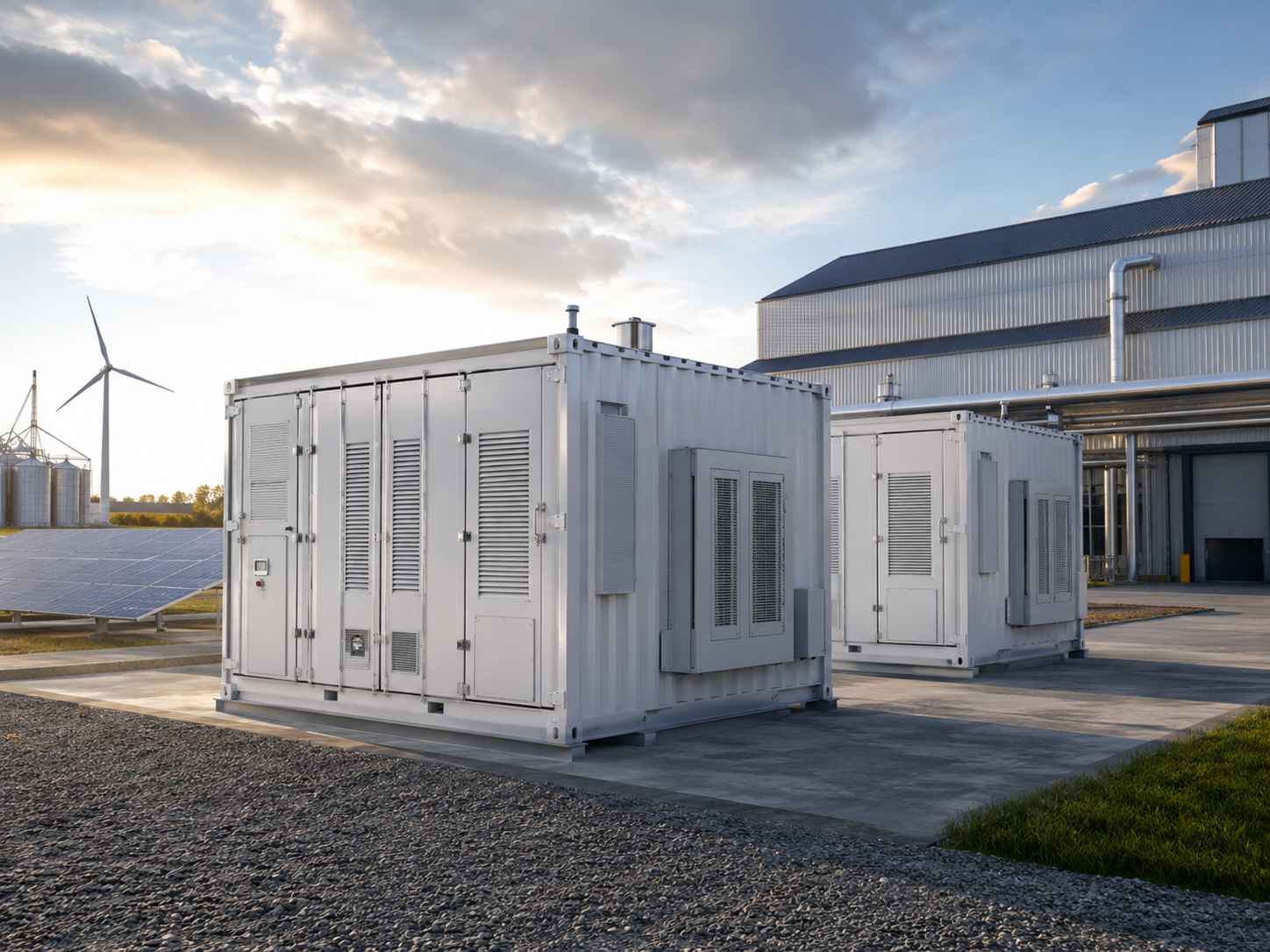
A container energy storage system is becoming a practical option for factories, farms, commercial buildings, EV charging stations, and renewable energy projects that need scalable power storage. Compared with small cabinet systems, containerized solutions can integrate larger battery capacity, PCS, BMS, EMS, cooling, and fire protection into one transportable structure.
For project owners, the value is not only storage capacity. The system should help improve power reliability, reduce peak demand, store solar or wind energy, support microgrid operation, and provide backup power when the grid is unstable. SAMAS provides a dedicated Container Energy Storage System for C&I and renewable projects, and buyers can also compare the full Commercial & Industrial Energy Storage Systems category.
A container energy storage system is a large battery storage solution installed in a container structure. It stores electricity from the grid, solar power, or wind power, then discharges that energy when demand increases, electricity prices rise, or backup power is required.
A containerized energy storage system usually includes battery racks, power conversion system, battery management system, energy management system, thermal management, fire protection, and communication modules. This integrated design makes transportation, installation, and future expansion easier than building a customized storage room from the beginning.
The U.S. Energy Information Administration explains that energy storage can charge from electricity or another energy source and discharge at desired power levels when needed. This general concept is useful for understanding the role of BESS in grid and commercial applications: energy storage for electricity generation.
Containerized energy storage is especially useful when a project needs high capacity, predictable installation, and long-term operation. Common applications include factories, industrial parks, solar farms, wind power projects, farms, mines, remote microgrids, ports, logistics centers, and EV charging stations.
Scenario | Main Power Problem | How Container Storage Helps |
Factory | Peak demand and unstable power quality | Supports peak shaving, backup and load scheduling. |
Farm or agricultural base | Remote location and renewable energy fluctuation | Stores solar or wind power for irrigation, lighting and equipment. |
EV charging station | High short-term load | Buffers charging demand and can combine with PV. |
Industrial park | Multiple tenants and flexible demand | Supports centralized energy management and backup. |
Solar farm | Intermittent generation | Stores excess solar energy and improves dispatchability. |
Remote microgrid | Weak or unavailable grid | Provides stable local power with renewable generation. |
A commercial battery storage system should be reviewed as a complete system rather than a battery pack alone. Buyers should evaluate battery cell type, cycle life, PCS rating, BMS protection logic, EMS scheduling functions, cooling method, fire protection, communication protocol, IP rating, and installation environment.
Module | Function | Buyer Concern |
Battery system | Stores electrical energy | Capacity, cycle life, safety and expansion. |
PCS | Converts DC and AC power | Rated power, grid compatibility and response speed. |
BMS | Monitors battery health | Protection, balancing and fault warning. |
EMS | Optimizes energy dispatch | Peak shaving, self-consumption and scheduling. |
Thermal management | Controls temperature | Stable operation in project environments. |
Fire protection | Improves system safety | Project compliance and risk control. |
Communication | Connects system data | Remote monitoring and integration. |
Sizing should start from the project objective. A factory focused on peak shaving needs load-profile data and local electricity tariff information. A solar project needs PV generation data and grid connection requirements. A backup-power project needs critical load and required backup duration. Without these inputs, the system may be too small to solve the problem or too large to deliver a reasonable return on investment.
SAMAS container storage models can support commercial and industrial applications with integrated battery, PCS, BMS, EMS, thermal management, and safety protection. For specific projects, buyers should share location, load profile, backup target, renewable energy input, grid condition, and expansion plan with the SAMAS engineering team through the Battery Energy Storage System Design page.
A container system is better for larger capacity, centralized deployment, and renewable-energy projects. An outdoor cabinet may be better for smaller commercial sites, telecom, distributed commercial buildings, or limited-space projects. The right choice depends on power rating, installation space, expansion need, and budget.
For buyers who are not sure which format fits their project, the best next step is to compare site load, space, and capacity. SAMAS can provide selection guidance from Commercial & Industrial Energy Storage Systems to container, cabinet, or PV-storage integrated solutions.
SAMAS supports energy storage projects across portable, residential, C&I, and vehicle battery applications. For project buyers, the advantage is the ability to discuss battery capacity, PCS power, cooling method, monitoring, and project scenario together rather than buying isolated components.
To start a project discussion, review the SAMAS Container Energy Storage System and then contact SAMAS with the project location, load demand, installation conditions, and required backup time.
A container energy storage system is suitable for factories, farms, commercial sites, and renewable projects that need scalable, integrated, and reliable power storage. To select the right system, buyers should evaluate application scenario, load profile, capacity, PCS power, cooling, fire protection, communication, and future expansion. SAMAS can help project teams choose a containerized or cabinet-based solution according to real site requirements.
A container system is usually larger and more suitable for high-capacity C&I or renewable projects. A cabinet system is usually more compact and suitable for smaller distributed sites.
Yes. Container storage can be integrated with solar PV to store excess generation and discharge power when demand is higher or sunlight is unavailable.
Buyers should provide load profile, backup duration, installation site, grid condition, renewable input, and expected expansion plan.
Yes. It can buffer high charging loads, support PV integration, and improve power reliability for charging infrastructure.