For RVs, utility vehicles, golf carts, service vehicles, and mobile auxiliary power, battery choice directly affects weight, runtime, maintenance, and user experience. Many buyers are now comparing vehicle power batteries based on LiFePO4 chemistry against traditional lead-acid batteries because lithium solutions can reduce weight, improve usable capacity, and support longer service life in many mobile applications.
SAMAS provides Vehicle Power Batteries for RVs, utility vehicles, golf carts, industrial vehicles, special vehicles, and lead-acid replacement projects. Buyers can also review the LiFePO4 12V Battery page for auxiliary power and vehicle parking power supply applications.
Vehicle power batteries are battery systems designed to supply energy for mobile applications. Depending on the vehicle type, they may support traction power, auxiliary equipment, onboard appliances, parking air conditioning, lighting, communication devices, or outdoor power needs.
The right battery depends on voltage, capacity, discharge current, installation space, charging method, expected service life, weight target, and safety requirements. For B2B buyers, the decision should also consider warranty, packaging, delivery, certification, and whether the supplier can support customization.
For a general reference on lithium-ion batteries in electric vehicles, the U.S. Department of Energy Alternative Fuels Data Center notes that lithium-ion batteries have high energy per unit mass, high power-to-weight ratio, high energy efficiency, and low self-discharge: Batteries for Electric Vehicles.
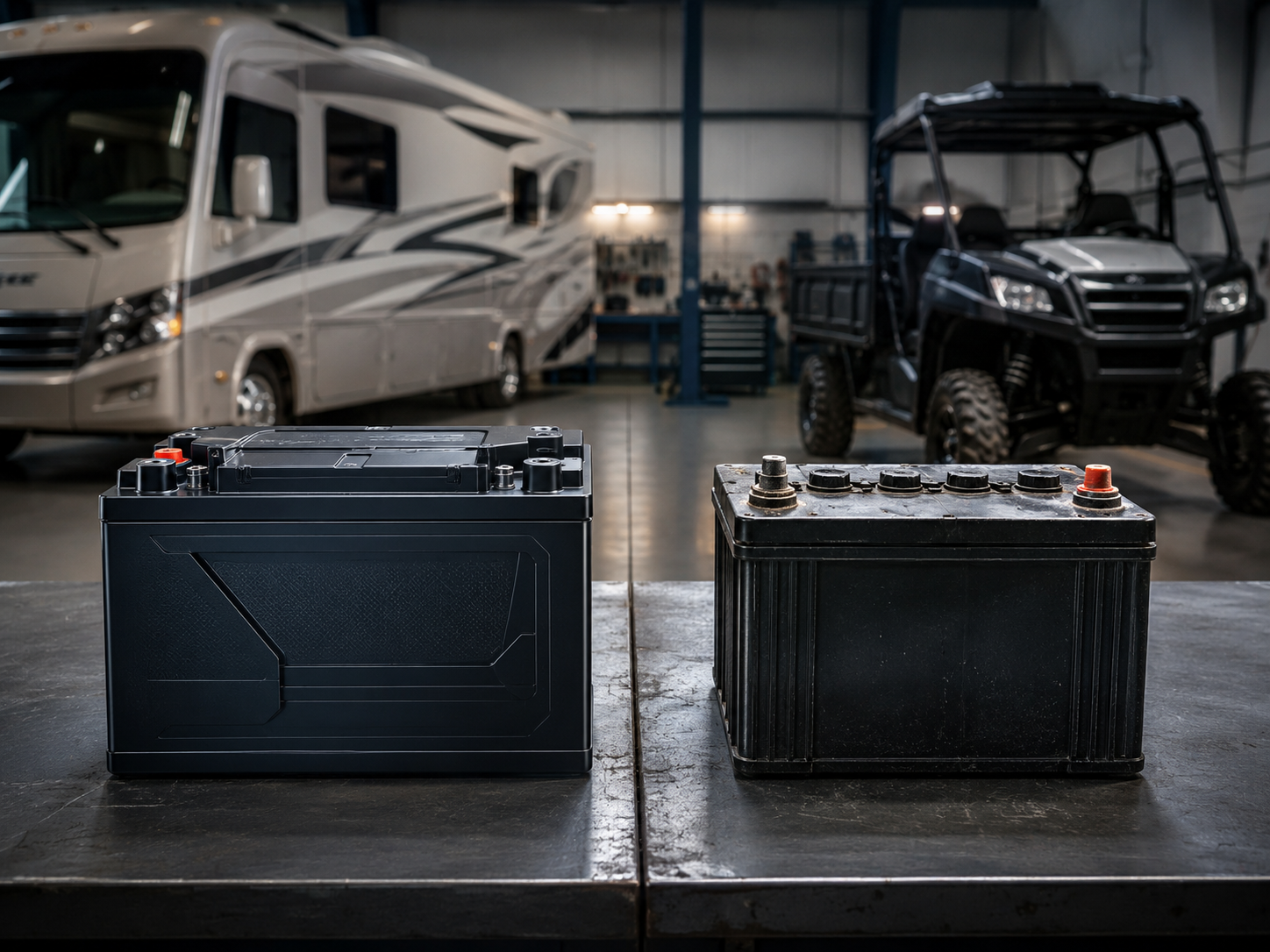
A LiFePO4 vehicle battery is a lithium iron phosphate battery. Compared with lead-acid batteries, it is often selected for lighter weight, deeper usable capacity, longer cycle life, and lower maintenance. Lead-acid batteries can still be attractive for low-cost replacement, but they are heavier and usually provide less usable energy under deep discharge conditions.
Comparison Factor | LiFePO4 Vehicle Battery | Lead-Acid Battery |
Weight | Usually much lighter | Heavier for the same usable energy. |
Usable capacity | Higher practical usable capacity | Deep discharge can shorten life. |
Cycle life | Generally longer under proper use | Usually shorter in deep-cycle use. |
Maintenance | Low maintenance with BMS | May require more maintenance depending on type. |
Charging | Can support faster charging if designed properly | Charging is usually slower. |
Initial cost | Higher initial price | Lower initial price. |
Long-term value | Often better for frequent-use vehicles | Suitable for budget-sensitive replacement. |
A lead-acid replacement battery is suitable when the buyer wants to upgrade an existing vehicle platform without redesigning the whole electrical system. Common projects include RV auxiliary power, golf carts, utility vehicles, mobile work vehicles, parking air conditioning, and onboard equipment.
However, the replacement process should not be treated as a simple battery swap in every case. Buyers must confirm voltage compatibility, physical size, maximum discharge current, charging system, BMS protection, and installation safety. A supplier should help check the application before recommending a model.
LiFePO4 batteries are particularly valuable in applications where weight, reliability, and cycle life matter. RV users want longer appliance runtime and less weight. Golf carts and utility vehicles need stable power and daily cycling. Trucks with parking air conditioning need reliable auxiliary power. Industrial vehicles need safe, repeatable performance.
Application | Main Battery Requirement | Why LiFePO4 Can Help |
RV auxiliary power | Long runtime and low weight | Supports appliances, lighting, and outdoor power needs. |
Golf cart / utility vehicle | Daily cycling and stable discharge | Improves usable capacity and reduces maintenance. |
Truck parking air conditioning | Reliable auxiliary power | Supports comfort loads when engine is off. |
Industrial vehicle | Stable performance and durability | Suitable for repeated charging and discharging. |
Outdoor service vehicle | Portable power and onboard equipment | Helps support field tools and communication devices. |
Before ordering vehicle power batteries, buyers should prepare vehicle type, voltage platform, required capacity, maximum discharge current, charging equipment, installation dimensions, ambient temperature, and expected daily use. If the product will be sold through distribution channels, packaging, labels, manuals, and after-sales documentation should also be confirmed.
SAMAS offers both LiFePO4 12V Battery options and Small Power Battery solutions. For custom projects or bulk procurement, buyers can contact SAMAS to discuss configuration, target application, and market requirements.
Choose LiFePO4 when the target user values longer life, lighter weight, deeper usable energy, and lower maintenance. Choose lead-acid only when initial purchase cost is the main concern and performance requirements are modest. For many professional vehicle and RV applications, the long-term value of LiFePO4 can be stronger even when the initial price is higher.
A practical decision method is to calculate total cost over expected years of use, not just upfront battery price. Consider replacement frequency, downtime, weight impact, available capacity, and user satisfaction. For B2B buyers, these factors affect repeat sales and brand reputation.
Vehicle power batteries should be selected according to real vehicle use, not only battery price. A LiFePO4 vehicle battery is often better for RVs, utility vehicles, golf carts, and auxiliary power systems that need lighter weight, longer service life, and stable output. A lead-acid replacement battery project can be successful when compatibility, charging, and BMS protection are checked carefully before ordering.
In many applications, yes, but buyers must check voltage, size, charging method, discharge current, and BMS compatibility before replacement.
Yes. They are commonly selected for RV auxiliary power because they can reduce weight and provide longer usable energy than many lead-acid options.
Provide vehicle type, voltage, capacity target, load type, installation space, charging method, quantity, and packaging requirements.
Not always. LiFePO4 is usually better for long-term performance, but lead-acid may still fit very low-cost or low-demand applications.